
Kamon Symbols and Their Meanings
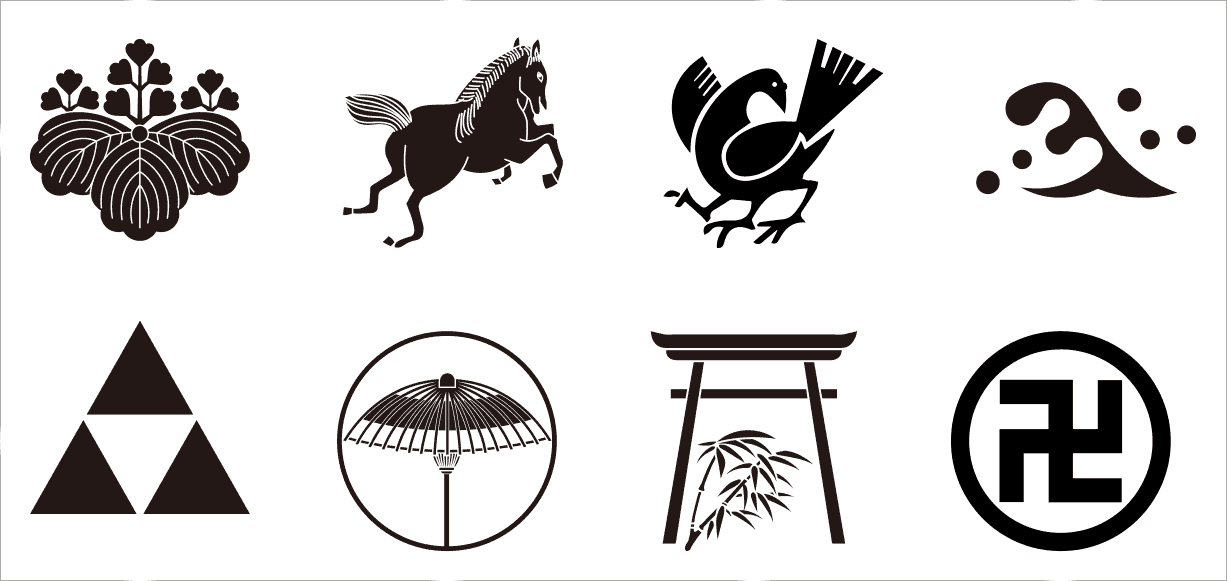
Many Japanese kamon are based on natural forms and familiar objects. Flowers, leaves, birds, feathers, tools, and geometric shapes were all used as family symbols. Understanding the motif is often the first step in identifying a kamon.
What do kamon symbols represent?
Kamon motifs often reflect the natural world, everyday tools, or abstract shapes. Some designs were chosen because of family names, while others symbolized status, beauty, protection, strength, or religious associations.
In many cases, the same motif appears in many different forms. The meaning of a kamon is therefore not only in the motif itself, but also in the arrangement, number, and surrounding shape.
Most Famous Kamon Motifs

Some kamon motifs became especially famous because they were used by powerful samurai clans or frequently appeared in Japanese history and culture. These motifs are often recognized even by people who are not familiar with kamon.
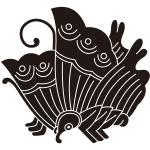
Butterfly
A graceful symbol associated with court culture and samurai families. Butterfly crests are among the most elegant designs in Japanese heraldry.

Tomoe
A swirling symbol often associated with shrines, movement, and protection. Tomoe designs are widely used across Japan.
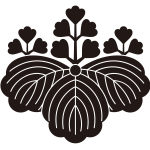
Paulownia (Kiri)
One of the most prestigious motifs in Japanese heraldry. It became associated with high rank and later with the Toyotomi government.

Takeda-bishi
A bold geometric crest famously used by the Takeda clan during the Sengoku period. Its diamond pattern is instantly recognizable.

Bamboo and Sparrow
A popular motif associated with samurai families such as the Date clan. It combines strength (bamboo) with lively movement (sparrow).
More than 40,000 kamon designs exist in Japan, but many are variations of a few common motifs.
See more examples of samurai family crests on our Samurai Kamon page.
Plant Motifs
Plant motifs are among the most common in Japanese family crests. Flowers and leaves were elegant, recognizable, and easy to stylize into symmetrical designs.
- Paulownia (Kiri) – associated with rank and formal authority
- Wisteria (Fuji) – linked to noble and warrior families
- Bamboo (Take) – resilience and upright character
- Plum (Ume) – beauty and endurance in winter
- Oak leaves (Kashiwa) – continuity and family line
Animal and Bird Motifs

Animal motifs include birds, butterflies, marine creatures, and legendary animals. These designs often express movement, grace, vigilance, or good fortune.
- Butterfly – elegance, transformation, courtly culture
- Crane – longevity and auspicious meaning
- Sparrow – often paired with bamboo; a famous samurai motif
- Hawk feathers – martial strength and precision
- Crab – rare but distinctive; often linked to visual resemblance or local tradition
Geometric Motifs

Some kamon are based on pure geometric shapes rather than natural motifs. These designs are especially common among warrior families because they are bold, easy to distinguish, and highly adaptable.
- Diamonds / lozenges – clean, strong, and formal
- Tomoe – swirling forms associated with movement and protection
- Circles – enclosure, unity, and distinction
- Cross-like forms – sometimes derived from tools or stylized emblems
Objects and Tools

Many crests use tools, architectural elements, or ceremonial objects. These motifs could reflect a family name, occupation, territory, or historical event.
- Fan – elegance and rank
- Arrow / feather – martial use and hunting symbolism
- Well frame – place-based origin or family name
- Wheel – movement, transport, or Buddhist symbolism
How to Identify a Kamon Motif

When trying to identify a crest, first look for the main motif. Then check whether the crest is enclosed in a circle, how many elements it contains, and whether the design faces a particular direction.
- Main motif (flower, bird, leaf, tool, etc.)
- Presence or absence of a circle
- Number of repeated elements
- Direction and arrangement
Even small changes can result in a completely different kamon.
Browse Kamon by Symbol
If you are looking for a crest based on a motif, you can explore more examples in our reference pages.
Download Kamon Data
Selected kamon designs are available as downloadable data for publishing, design, and personal projects.
- Web-size PNG
- High-resolution PNG
- Vector formats (AI / EPS / PDF)
Many traditional Japanese kamon can be downloaded for use in design, research, or historical projects.
Commercial use requires licensing. After purchase, editing and resizing are allowed for your project, but redistribution of the source data is not permitted.
Contact
If you are looking for a specific crest motif or need a higher-resolution file, please contact us with the motif name or a reference image.

